

Creatives, with Agency
You've been building for everyone else. Time to build for you.

Your Work. Their Voice.
Picture a ghostwriter. They’ve written novels, speeches, screenplays, comms for CEOs and juicy celeb tell-alls. Prolific, professional. Volumes of work, but written in others’ voices.
A lot of creatives are a version of that writer right now. And yet, We are, objectively, the most skilled creative builders in the modern economy. We don’t just talk the talk. We can make it happen.
We know how to make. Execute. Position things. Build brands that feel familiar, desirable, and inevitable. We write the copy that moves people, design the identities that drive viral products and craft the narratives that turn products into cultural moments. We do this, reliably, for other people’s ideas. We do it well. We do it on deadline.
And then we go home.
The capital-A Agency was built on that arrangement. It standardized the creative skillset, industrialized ideas, and put a name to the creative skill set. Agency pros demonstrated that creativity wasn’t just hereditary, it was a skill that could be honed, and learned over time.
The agency also centralized the talent, sold access to it, rinsed and repeated. For decades, it worked. But that model has been eroding for years: in-housing, consolidation, procurement treating creative like a commodity, project work replacing the retainer. AI didn’t create this problem. It just made the decay undeniable.
Which means a lot of creatives are suddenly in unfamiliar territory. Not because our skills diminished. Because the structure around our skills is reorganizing faster than anyone planned for.
The instinct, when the ground shifts, is to wait for it to settle. Find the next agency. The next brand team. The next brief.
But there’s another move. It’s not an agency. It’s YOUR agency.
You Had The Tools the Whole Time
Here’s what I’ve noticed over the past few years, writing Chaos Era and looking at the changes in our industry: the skills you’ve been treating as a service are actually a blueprint for building. Positioning, narrative, voice, identity—these aren’t just deliverables. They’re the exact capabilities that founders, operators, and indie builders spend years trying to acquire or afford. You already have them. You’ve had them the whole time.
The gap was never capability. It was permission. The brief no one gave you was the one for yourself. Your ideas. Your brand.
And here’s where it gets juicy. The gap between ideas and execution is smaller than it’s ever been. TikTok and Social “Creators” get a bad rap, they’ve been running laps around the ‘professional’ agency world for years. Armed with ring-lights, tiny mics, and amateur gear, they went to work. Even if they sucked at first, they kept going. Kept shipping work. Building audiences, brands, and distribution networks that allowed them to build entire empires.
And then came AI—closing the distance between having an idea and shipping it in a way that didn't exist even three years ago. The things that used to require a technical co-founder, a growth team, a production budget—a lot of that is now accessible to anyone with craft, instincts and the willingness to wield their tools.
Creatives are uniquely positioned for this moment because we already understand what “good” looks like. We just need to start demanding it for our own work.
Who’s Doing this Well?
There are three creatives that instantly come to mind when I think of high-agency era. These folks put their money where their mouth is, built brands, and have created their own universes, and their own lanes.
Caleb Flowers
Caleb Flowers has been doing this longer than most people realized it was possible. A skater and designer based in Salt Lake City, he spent years running Hathenbruck — the only boutique in the city carrying Raf Simons and Margiela, introducing a market to designers it didn’t know it needed yet.

Since then he’s founded Bruhlers, Chillbies, and Good Zones, while consulting with Stussy and Nike on product development and design. He’s not waiting for a seat at anyone’s table, he built a new table. When I asked him what it’s like operating as a designer outside the traditional creative hubs, he didn’t hesitate:
“I don’t worry about jumping into the party. I’ll just start my own.”
Jackie McKeown
Jackie McKeown spent years as a stylist—building other people's looks, other people's brands. Then she and her partner Fran Miller co-founded Literary Sport, and the industry took notice. Described as "The Row of athleisure," the brand has grown rapidly since its 2024 launch, fusing fashion sensibility with high-performance activewear in a way the category hadn't seen.

But Literary Sport is only part of the picture. McKeown also founded Garden Groupe Ltd, the product agency that powers F. Miller Skincare — another brand she and Fran built together. She didn't just turn her creative tools on herself once. She built an ecosystem and operating system for the rest of her ideas and ventures. The throughline is a stylist who stopped dressing other people's ideas and started architecting her own.
Oren John
Oren John, “The Internet’s Creative Director”, didn’t wait for permission to build. Starting as a graphic designer in New York, he moved fluidly between creative direction, marketing leadership, and founding roles—not because the path was linear, but because he kept asking what else was possible. He’s helped launch consumer drone categories, scaled a toy company to fastest-growing in America, and stepped into the president’s chair at a 200-person cannabis brand house that was eventually acquired.
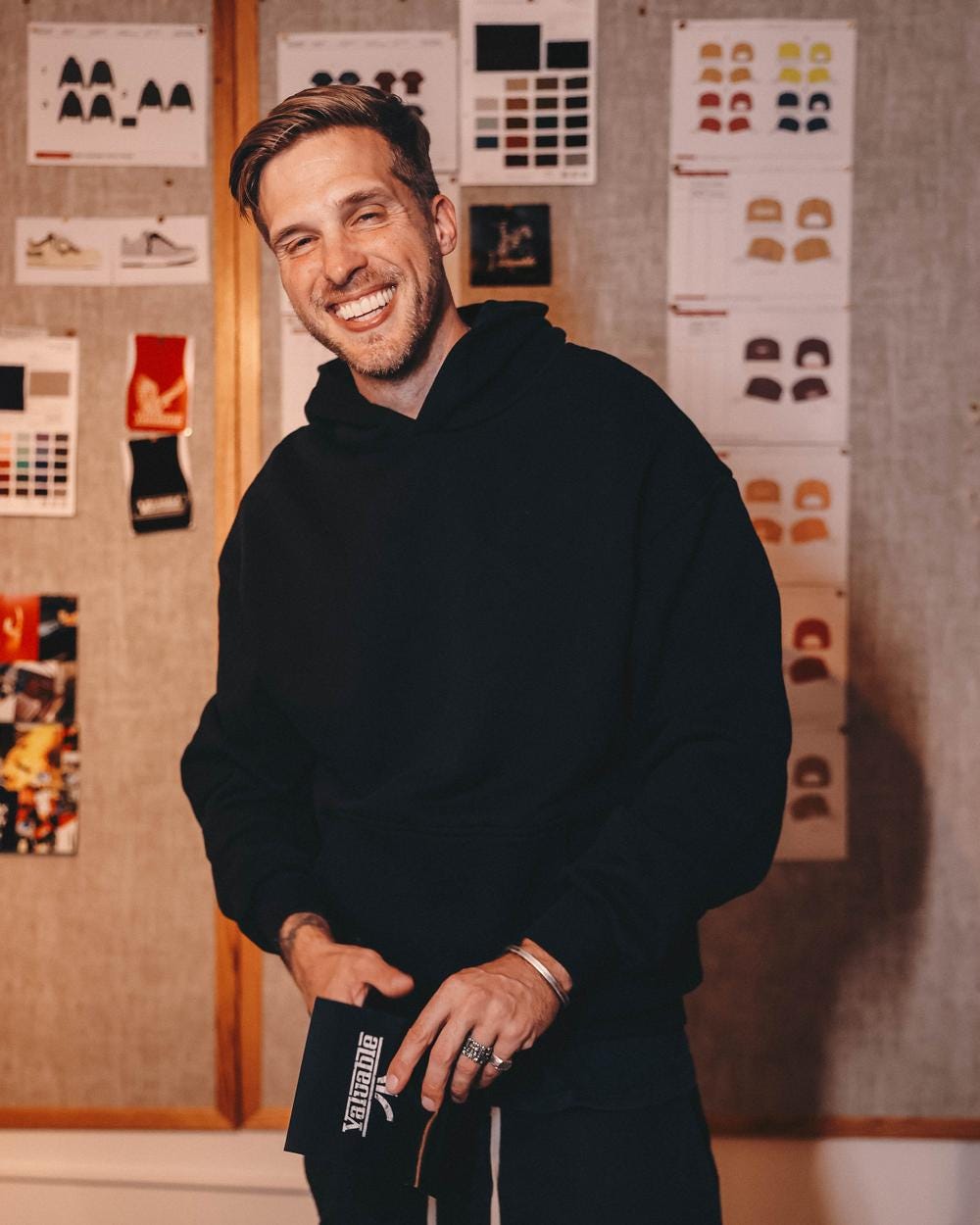
What’s consistent across all of it is his instinct. Oren treats creative and strategic capability from a founder mindset, not just a service offering. He’s an investor, a brand partner, a content creator, and an operator, often simultaneously. And when he decided he had something worth saying about brand strategy and product development, he didn’t pitch a column. He built HYPER—a newsletter and resource center on his own terms, for his own audience.
A Challenge: For You and For Me
So what’s my challenge to you? Stop waiting for the brief. Stop waiting for the right role, the right agency, the right moment for the industry to stabilize. It won’t. This is the terrain now, and the creatives who thrive in it won’t be the ones who adapted— they’ll be the ones who decided.
You already know how to build something worth believing in. The skills are there. The taste is there. The instincts you’ve spent years sharpening for other people’s problems are exactly what this moment is asking for.
If you feel stuck, start small. If you’re an art director, direct something of your own. If you’re a strategist, write the brief you always wished a client would hand you. A photographer, shoot for yourself. A writer? Write the thing that scares the shit out of you to tackle. These skills are the one thing no one can reorganize out from under you. They’re yours. Use them.
For years, I called myself a builder. And I was—just never for myself. Every capability I developed, every tool I sharpened, went into someone else’s vision. This series is my attempt to change that. Resolut started as an experiment. Sundree started as a scratch-your-own-itch idea.
Both became proof that the gap between concept and shipped product is smaller than I thought—and that creative instincts are a serious advantage when you’re the one holding the brief, and the tools.
I have a few more ideas I’ve been dying to bring to life. Over the next few months, I’ll be building in public, sharing what’s working, what’s breaking, and what it actually feels like to put your whole creative toolkit in service of your own vision. Come along if that sounds interesting.
It’s terrifying. It’s also the most alive I’ve felt doing this work in years.
Stay Sharp.